The inverse of a function is defined as f^-1(x).
2 functions; F and G, are inverses iff (f(g(x)) = g(f(x))
In other words, when the input is the output, where there is no net change.
To find the inverse of a function:
Example:
f(x) = 2x+5
f^-1(x) = ?
You would perform the following:
the original function is:
f(x) = 2x+5
and since f(x) is equal to y...
y= 2x+5
then you switch x and y...
x= 2y+5
and then you solve for y...
x-5 = 2y +5 -5
x-5= 2y
(x-5) /2 = 2y /2
y= (x-5) /2
and so:
f^-1(x) = (x-5) /2
to validate, you would show that f(f^-1(x)) = f^-1(f(x))
so;
f(f^-1(x)) = f((x-5) /2)
= ((2x+5)-5) /2
= 2x /2
= x
f^-1(f(x)) = f^-1(2x+5)
= 2((x-5) /2) +5
= x
so the inverse is correct because both equations come out to x
One-to-one means that for every y value, there is only one x value
a function f is one to one iff f(a) = f(b) implies a=b
ex:
f(x) = 2x+5
f(a) =2a+5 f(b) =2b+5
-5 -5
f(a) =2a f(b)= 2b
/2 /2
a=2=b
a=b
so the function is one to one
one-to-one functions must pass the horizontal line test, which must be true to have an inverse that is a real function.
Thursday, September 30, 2010

Tuesday, September 28, 2010
Compositions of Functions
Today we learned about composition of functions.
Another way of combining two functions is to form the composition of one with the other. For example, if f(x) = x^2 and g(x) = x + 1, the composition of f with g is:
f ( g( x ) ) = f ( x + 1 ) = ( x + 1 )^2
The composition of the function f with g is:
( f o g ) ( x ) = f ( g ( x ) )
The domain of f o g is the set of all x in the domain of g such that g(x) is in the domain of f.
EXAMPLE:
f(x) = 2x+4 and g(x) = x^2 - 7
(f o g) (x) = f (g(x))
= 2(x^2 - 7) + 4
= 2x^2 - 14 + 4
= 2x^2 - 10
Another way of combining two functions is to form the composition of one with the other. For example, if f(x) = x^2 and g(x) = x + 1, the composition of f with g is:
f ( g( x ) ) = f ( x + 1 ) = ( x + 1 )^2

The composition of the function f with g is:
( f o g ) ( x ) = f ( g ( x ) )
The domain of f o g is the set of all x in the domain of g such that g(x) is in the domain of f.
EXAMPLE:
f(x) = 2x+4 and g(x) = x^2 - 7
(f o g) (x) = f (g(x))
= 2(x^2 - 7) + 4
= 2x^2 - 14 + 4
= 2x^2 - 10
Section 1-3 Shifting, Reflecting, and Stretching Graphs
Sunday, September 26, 2010
By: James Thomas
To understand how graphs can shift and reflect you must first know about the parent functions of the graph.
Parent Function: The most basic form of a equation for a graph.
Vertical and Horizontal Shifts
1) Vertical shift c units upward h(x)=f(x)+c
2) Vertical shift c units downward h(x)=f(x)-c
3) Horizontal shift c units to the right h(x)=f(x+c)
4) Horizontal shift c units to the right h(x)=f(x-c)
Example:
- g(x)=(x-2)2+3
Parent function = g(x)=x2
Horizontal Shift = -2....... Right Three (Translate the opposite of the sign)
Vertical Shift = +3...... Up Three

Reflecting Graphs
Graphs can also be reflected over the x-axis and y-axis depending on a (-) sign in the equation.
- Reflection over the x-axis h(x)=-f(x)
- Reflection over the y-axis h(x)=f(-x)
Example:

Nonrigid Transformations:
- Rigid Transformations- Horizontal and Vertical Shifts because they dont affect the graphs shape or structure, just the location.
- Nonrigid Transformations - Causes a distortion in the graph making it skinnier or fatter.
y=cf(x)
- Skinny Transformation = 0 < c < 1
- Fatter Transformation = c > 1
Example:
- g(x) = 3x2 , g(x)= 1/4x2

Monday, September 27, 2010
Arithmetic Combinations
Today we reviewed Arithmetic Combinations.
They are as follows:
(let f(x) = 3x + 2 and g(x) = x^2 - 5x)
addition - (f+g)(x) = f(x) + g(x)
ex. (f+g)(x) = 3x + 2 + x^2 - 5x
(f+g)(x) = x^2 - 3x + 2
subtraction - (f-g)(x) = f(x) - g(x)
make sure to distribute the minus sign throughout the the function g(x)
ex. (f-g)(x) = (3x + 2) - (x^2 - 5x)
(f-g)(x) = 3x + 2 - x^2 + 5x
(f-g)(x) = -x^2 + 8x + 2
multiplication - (fg)(x) = (f(x)) (g(x))
ex. (fg)(x) = (3x + 2)(x^2 - 5x)
(fg)(x) = 3x^3 - 15x^2 + 2x^2 - 10x
(fg)(x) = 3x^3 - 13x^2 - 10x
division - (f/g)(x) = (f(x)) / (g(x))
watch out for extraneous solutions that might not have been extraneous when the
two functions were seperate
ex. (f/g)(x) = (3x + 2)
(x^2 - 5x)
x cannot equal 5
graphing arithmetic combinations
I'm sorry there are no graphs. For some reason I was unable to upload images. If anyone else can figure out a way to add some example graphs in a comment please do.
for addition and subtraction, add and subtract the y-coordinates
for multiplication and division, multiply and divide the y-coordinates
They are as follows:
(let f(x) = 3x + 2 and g(x) = x^2 - 5x)
addition - (f+g)(x) = f(x) + g(x)
ex. (f+g)(x) = 3x + 2 + x^2 - 5x
(f+g)(x) = x^2 - 3x + 2
subtraction - (f-g)(x) = f(x) - g(x)
make sure to distribute the minus sign throughout the the function g(x)
ex. (f-g)(x) = (3x + 2) - (x^2 - 5x)
(f-g)(x) = 3x + 2 - x^2 + 5x
(f-g)(x) = -x^2 + 8x + 2
multiplication - (fg)(x) = (f(x)) (g(x))
ex. (fg)(x) = (3x + 2)(x^2 - 5x)
(fg)(x) = 3x^3 - 15x^2 + 2x^2 - 10x
(fg)(x) = 3x^3 - 13x^2 - 10x
division - (f/g)(x) = (f(x)) / (g(x))
watch out for extraneous solutions that might not have been extraneous when the
two functions were seperate
ex. (f/g)(x) = (3x + 2)
(x^2 - 5x)
x cannot equal 5
graphing arithmetic combinations
I'm sorry there are no graphs. For some reason I was unable to upload images. If anyone else can figure out a way to add some example graphs in a comment please do.
for addition and subtraction, add and subtract the y-coordinates
for multiplication and division, multiply and divide the y-coordinates
Monday, September 20, 2010
Chapter 1 Section 2
Even and Odd Functions
By: Scott Simon


Since the opposite of x makes this function the same as it was with x, it is an even function.


Homework: section 1.2 #'s 47-49,51, 61-71 odd
Today in class we learned that functions can be even, odd, or neither even or odd.
A function is an even function when you plug in the opposite of x (which is negative x) for x and the function remains as it originally was.
Example:


Since the opposite of x makes this function the same as it was with x, it is an even function.
If the opposite of x in a function makes it the opposite of the original function, then it is an odd function.
Example:



This looks like the opposite, but you have to check by solving for the opposite of the function, which means multiplying the whole function by -1. If it is not actually the opposite, then it is neither even nor odd.


This proves that are are opposites, so this function is an odd function.
Sunday, September 19, 2010
Chapter 1 Section 2
Graphs of Functions
Homework: Section 1.1 #66,70,95 and Section 1.2 #31-35 odd, 44-46, 85, 86, 89-94, 97, 111, 113
x=the directed distance from the y-axis (domain)
f(x)= the directed distance from the x-axis (range)
Today in class we went over how to read if a graphs function is increasing, decreasing, or staying constant. A function "f" is increasing on an interval if for any X1 and X2 in the interval X1 less than X2 implies F(X1) is less than F(X2).
Increasing, Decreasing, and Constant Functions:
Increasing- X1< implies=""> f(X2).
Constant-f(X1)= f(X2)


The graph below increases on the left side and begins to decrease a bit as you go towards the right.
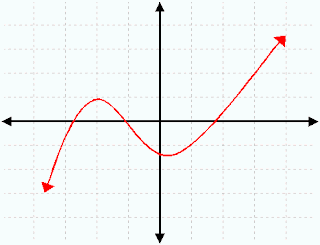
moving left to right
(if it's to the left it's less than)
EXAMPLE: f(x)=x^3
Although it may appear that there is an interval in which this function is constant, you can see that if X1<>
Graphs of Functions
Homework: Section 1.1 #66,70,95 and Section 1.2 #31-35 odd, 44-46, 85, 86, 89-94, 97, 111, 113
x=the directed distance from the y-axis (domain)
f(x)= the directed distance from the x-axis (range)
Today in class we went over how to read if a graphs function is increasing, decreasing, or staying constant. A function "f" is increasing on an interval if for any X1 and X2 in the interval X1 less than X2 implies F(X1) is less than F(X2).
Increasing, Decreasing, and Constant Functions:
Increasing- X1
Constant-f(X1)= f(X2)
The graph below increases on the left side and begins to decrease a bit as you go towards the right.

moving left to right
EXAMPLE: f(x)=x^3

Although it may appear that there is an interval in which this function is constant, you can see that if X1<>
Wednesday, September 15, 2010
Chapter 1 Section 1
Functions 9/15/2010 By: Emily Smith
--> This is not a function. As you can see when you use the vertical line test it crosses the blue line twice therefore it is not a function.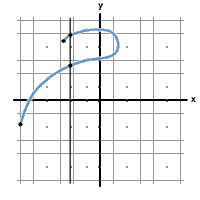
--> This is not a function. As you can see when you use the vertical line test it crosses the blue line twice therefore it is not a function.


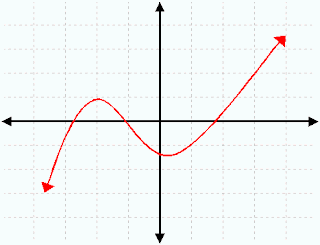
<---- This is a function. If you use the vertical line test and move the line vertically throughout the entire graph it only crosses each part of the red line once.
Today in class we were introduced to the chapter on functions. A function is a relation where every value in the domain is assigned one value in the range. Or as we have all heard before for every input there is only one possible output. The domain is the set of x values. This set of numbers is also referred to as the possible inputs or the independent variable. The range is the set of y values. This set of data is also referred to as the possible outputs or the dependent variable. If an equation is written as y=x^2 then it is a function. If an equation is written as y^2=x it is not a function. The variable y with any power= x are normally not functions and absolute values are also not normally functions. To see whether or not a graph is a function you must use the vertical line test. The vertical line should only pass through one line on the graph. If it passes through more than one then it is not a function. Our homework for the night is Section 1.1 #1-6, 18-24,26,31-33,37,43,46-56 even
Example:
Set of values that is a function: (-3,2) (-1,1) (0,0) (1,5) (2,8)
Set of values that is not a function: (-4,-2) (-4,4) (0,0) (2,4) (3,6)
Subscribe to:
Posts (Atom)